

Preschool and Elementary
Enrolling now!
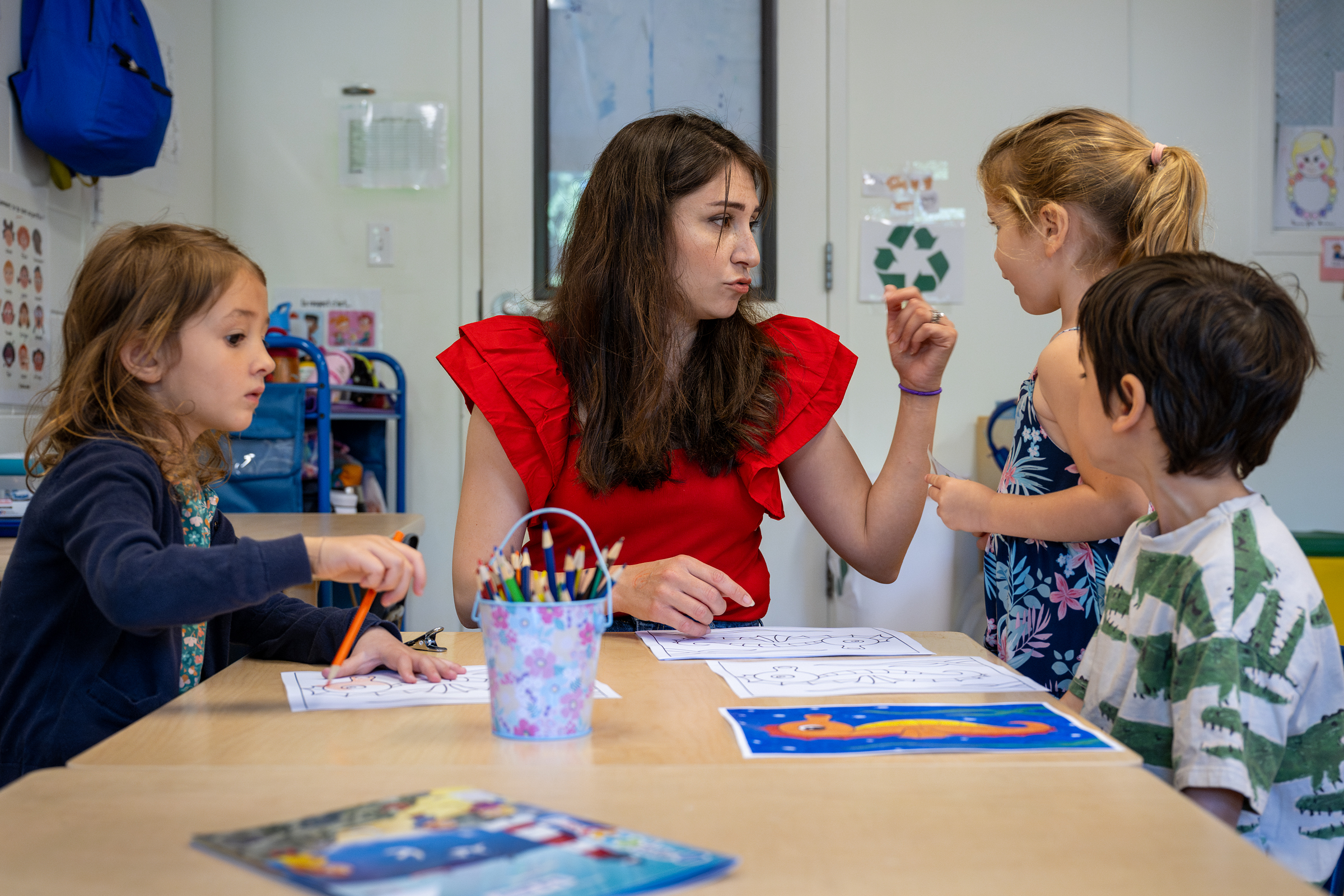
We provide fully immersive, joyful, and explorative classes that encourage young learners to engage actively and independently.
Bilingual education from 21 months through 5th grade.
*No French required through K

Preschool & Elementary inquiry form

Preschool
A Curriculum Aligned with the French National Education Standards
We have created a fully immersive program in French to facilitate French language mastery early on, while also introducing students to important skills for school preparation.
Learn and live together
Socialization is a key part of the preschool experience. Students will develop skills for communal life, such as rules of conduct, respect, and empathy for others. They will form relationships with new adults, discover the purpose of school, and understand how school life is organized. As they grow, students will learn what it means to be a student—gaining independence, showing initiative, and taking responsibility for their actions and tasks. At the same time, they will also learn to express their individuality while finding their place within the group.
Mastering the French language
At EFB, the entire school day is taught in French, with curriculum materials designed to support language mastery. Our oral language program helps students express themselves clearly, structure sentences, expand their vocabulary, engage in collaborative learning, and develop phonics and pre-reading skills. For written language, students are guided in listening to and understanding stories, discovering the functions of writing, learning letter-sound relationships, and beginning to create their own short texts. This immersive approach fosters strong communication skills and a solid foundation in French literacy.
Early math Foundations
At EFB, students develop a strong foundation in mathematics through hands-on exploration and problem-solving. They discover numbers and their uses by learning sequences, reading and writing digits, and recognizing analog symbols such as dice patterns and finger counting. They estimate and compare quantities, use numbers to describe positions, and solve simple math problems involving addition, subtraction, and sharing. Students also explore geometry by identifying and manipulating 2D and 3D shapes, understanding sizes, and recognizing structured patterns. Through activities like sorting objects by height, weight, and capacity, as well as solving logic puzzles, they build essential reasoning and problem-solving skills.
Exploring the world
We cultivate curiosity and critical thinking by introducing students to scientific and historical exploration through observation, hands-on activities, questioning, and reasoning. They develop an understanding of space and time concepts while exploring the world of living things, objects, and matter.
Students also learn about hygiene, health, and the importance of a balanced diet. They are taught to recognize potential risks in their environment and to adopt responsible attitudes toward respecting spaces and protecting living beings, fostering an early awareness of sustainability and safety.
Creative activities
Students engage in weekly artistic activities, discovering various artworks and artists while using the arts as a means of self-expression, learning, and connection to the world. In visual arts, they experiment with different tools and mediums, practice drawing, create personal and group compositions, and explore graphic elements. In music education, they develop their voices, explore pitch, intensity, rhythm, and nuance, memorize and perform songs, and handle musical instruments. Through the arts, students also strengthen communication skills by describing artworks, expressing their emotions and interpretations, and using specific artistic vocabulary.
Movement and motor skills
Physical activities help students develop motor skills while also fostering self-expression, teamwork, and body awareness. Through cross-disciplinary activities, they connect movement with concepts from math, language, and science, enhancing their overall learning experience. Each week, students engage in a variety of activities, including group games, running, jumping, throwing, and navigating different spaces and materials. They refine their coordination through obstacle courses and movement exercises. On a more artistic level, they explore dance, singing, and theatrical activities, combining physical expression with creativity.

Elementary
Growing English instruction
In the Elementary program, the proportion of English instruction gradually increases as students progress through the grades. It starts at 20% in CP (first grade) and steadily rises to 40% by CM1 and CM2 (fourth and fifth grades), ensuring a balanced and progressive bilingual education.
French / English languages
The Elementary school at EFB is a full-time program based on the French Ministry of Education curriculum. While our preschool (maternelle) offers full French immersion, elementary students transition into a structured dual-language program. This gradual approach helps them develop strong literacy skills in both French and English, with instruction reaching up to 60% in French and 40% in English by CM2 (5th grade) Our curriculum harmonizes the French Education standards with elements from the Massachusetts Department of Education and a broader multicultural perspective. This integration fosters excellent reading and writing skills, ensuring students thrive across all subjects while nurturing a love for lifelong learning.
Mathematics
Our curriculum emphasizes reasoning, problem-solving, and the development of logical, structured thinking. In the primary grades, students achieve key milestones in numeracy and arithmetic, mastering mental math strategies, written calculations, fractions, decimals, and problem-solving techniques across the four operations. They also explore measurements, including units, volume, and conversions. Geometry is introduced through the study of 2D shapes, solids, perspective, and coordinates. Additionally, students learn to interpret data through tables and graphs while solving proportionality problems, building a strong foundation in mathematical reasoning.
Sports and physical education
Physical Education is a vital part of our curriculum, designed to achieve five key objectives: – Develop motor skills and coordination – Acquire techniques and strategies through physical activity – Foster teamwork, responsibility, and respect for rules – Promote lifelong health and well-being through regular exercise – Cultivate an appreciation for sports and artistic movement At EFB, students engage in a diverse range of activities, including yoga, mini-fencing, French pétanque, ultimate frisbee, dance, classic rule-based games, track and field (running, jumping, and throwing), racket sports, and more. Our dynamic program encourages both physical fitness and a love for movement.
Science and Social Studies
Our curriculum fosters curiosity, observation, and critical thinking, guiding students in exploring their natural and human environment. In the early years, they develop an understanding of time and space using tools like calendars, clocks, and maps while observing seasons, animals, plants, and objects. As they progress, students delve deeper into scientific and social concepts. They explore living organisms, biodiversity, ecosystems, and nutrition, as well as the properties of matter, including states of water and basic electricity. They also study the Earth and sky, learning about seasons, moon phases, and landscapes. In technology, students discover how objects are designed and how machines function. Social studies introduce them to major historical periods, key figures, and significant events from prehistory to the present. They learn to analyze maps, describe urban and rural landscapes, and explore diverse ways of life worldwide. These first steps into scientific and historical inquiry provide a strong foundation for critical thinking and a broader understanding of the world.
Visual arts and art history
At EFB, students engage in regular artistic exploration, from visual and musical arts to performing arts, experimenting with various techniques and mediums. They are encouraged to discover artists, cultural professionals, museums, and artistic spaces while expressing their own perceptions, emotions, and creativity through personal projects. In music education, students build a rich repertoire of rhymes and songs while developing their listening skills through famous works. They learn to identify melodic themes, rhythms, tempo, intensity, and pitch. Art history is also introduced, integrated across disciplines to provide a deeper understanding of artistic expression and cultural heritage..
Civics and ethics
At EFB, students develop essential life skills through a curriculum that fosters ethical understanding, respectful behavior, and health and safety awareness. Supported by a dedicated team of SEL and learning support teachers, they cultivate kindness, empathy, cooperation, and effective communication while learning to recognize and manage their emotions. Through this program, students also build self-esteem, confidence, resilience, and a positive mindset. In civics, they explore key topics such as French republican values and symbols, community living, sustainability, and French and U.S. institutions, preparing them to become thoughtful, engaged global citizens.
Library
Our libraries across all three campuses offer a diverse selection of books in French and two other languages, providing valuable exposure to French and multilingual cultures. Weekly class visits and book borrowing opportunities ensure students have regular access to enriching reading materials, fostering a love for literature and language exploration.